Wall Street Shockwave: BlackRock Leaves NYC as Mayor Fires Back 🔥

Financial Giant Walks Away — Is New York Losing Its Grip? 💼
The announcement landed like a thunderclap in the heart of America’s financial capital.
After decades embedded in the skyline and psyche of New York, investment giant BlackRock, Inc.

confirmed it would officially relocate key operations out of the city, signaling what critics are calling one of the most symbolic corporate departures in recent memory.
Within hours, political tensions erupted, and Mayor Zohran Mamdani delivered a fiery response that has since ignited a national debate over taxes, public safety, corporate influence, and the future of Wall Street.
The decision was not framed as a sudden escape.
BlackRock executives described it as a strategic realignment, citing operational efficiency, cost optimization, and long-term growth considerations.
Yet the implications were unmistakable.
When the world’s largest ᴀsset manager—overseeing trillions of dollars in ᴀssets—signals a decisive move away from New York, the symbolism reverberates far beyond office leases and zip codes.

According to sources familiar with the transition, the firm’s leadership had been quietly evaluating relocation scenarios for months.
Rising commercial real estate costs, evolving remote work dynamics, and concerns about local tax burdens reportedly factored into the calculus.
While BlackRock will maintain a presence in New York, insiders suggest the center of gravity is shifting permanently.
Mayor Mamdani did not hide his frustration.
In a press briefing that quickly went viral, he accused corporate executives of abandoning the very city that enabled their ascent.
He argued that New York’s financial ecosystem—its workforce, infrastructure, and global prestige—helped build BlackRock into a powerhouse.
To withdraw now, he implied, sends a troubling message about corporate loyalty and civic responsibility.
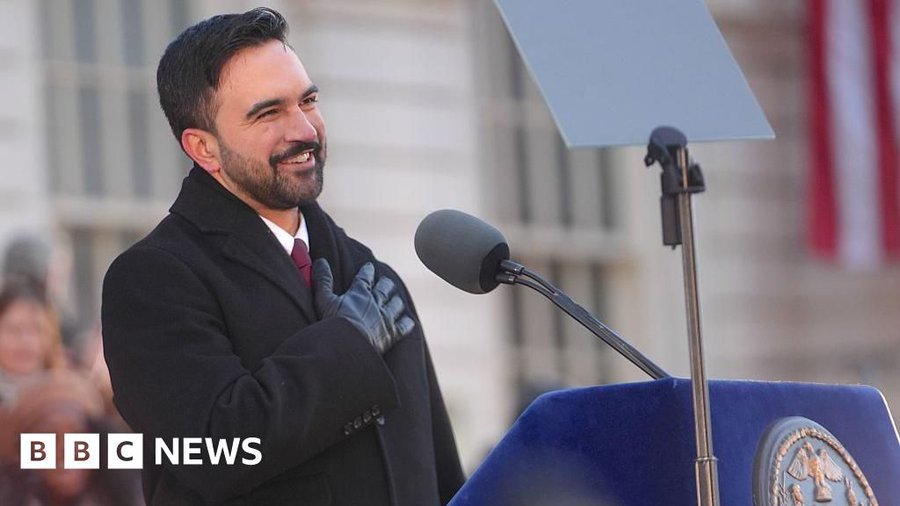
The mayor’s remarks were sharp, and at moments visibly emotional.
He framed the departure as part of a broader pattern of corporations leveraging relocation threats to secure tax concessions.
“New York built Wall Street,” he said, his voice rising.
“We will not be bullied into dismantling the protections and investments that make this city thrive.
”
Business leaders pushed back swiftly.
They argued that relocation decisions are rarely political statements and more often reflect fiduciary responsibility.
Shareholders expect executives to seek environments that maximize efficiency and profitability.
If another state offers lower taxes, reduced regulatory friction, or more favorable real estate terms, boards have an obligation to evaluate those options.
Financial analysts noted that New York has faced mounting pressure in recent years.
Post-pandemic remote work reshaped office demand.
Commercial vacancy rates climbed.
Crime headlines, whether statistically rising or not, affected perception.
Meanwhile, competing states aggressively courted financial firms with incentive packages and promises of streamlined oversight.
For critics of the city’s leadership, BlackRock’s exit underscores deeper structural challenges.
They point to corporate tax rates, congestion pricing debates, and contentious zoning battles as examples of policy uncertainty.
Some argue that a steady drip of high-profile departures erodes confidence in New York’s long-term compeтιтiveness.
Yet defenders of the city caution against alarmism.
New York remains home to the New York Stock Exchange, the Nasdaq, and countless financial insтιтutions whose global reach is unmatched.
Venture capital, private equity, fintech startups, and multinational banks still cluster densely in Manhattan.
One firm’s strategic shift, they argue, does not dismantle a financial ecosystem built over centuries.
Still, perception carries weight.
BlackRock’s brand is synonymous with modern ᴀsset management.
Its influence spans pension funds, sovereign wealth funds, and retail investors worldwide.
When such a firm recalibrates its geographic footprint, markets pay attention.
Employees are caught in the middle.
Some welcome relocation opportunities, enticed by lower housing costs and suburban lifestyles.
Others worry about uprooting families or losing proximity to the professional networks that New York uniquely provides.
Recruitment dynamics may also shift; firms often draw talent precisely because of the city’s density and energy.
Mayor Mamdani emphasized that the city would not engage in a race to the bottom.
He reiterated commitments to public services, transit infrastructure, and social programs funded in part by corporate tax contributions.
His stance resonates with consтιтuents who view large financial insтιтutions with skepticism, especially in the aftermath of past financial crises.
Opponents counter that inflexibility could accelerate departures.
They argue that cities compete globally for capital and talent.
If operating costs rise while alternatives grow more attractive, companies will migrate.
The tension between progressive governance and corporate mobility is not new, but BlackRock’s decision intensifies the spotlight.
Market reaction to the news was measured rather than chaotic.
Shares of BlackRock experienced modest fluctuations, reflecting investor focus on earnings fundamentals rather than geography alone.
Analysts highlighted that digital infrastructure and global diversification reduce dependence on any single headquarters location.
Nevertheless, the symbolic weight of leaving New York generated outsized headlines.
The broader context reveals a shifting financial landscape.
Technology enables distributed teams.
Regulatory frameworks differ widely across states.
Political polarization influences corporate strategy more openly than in previous decades.
Executives increasingly weigh reputational risk alongside operational cost.
In his remarks, Mayor Mamdani hinted at potential policy responses, including incentives for firms that commit long-term to the city and partnerships with emerging financial technology ventures.
He framed the moment as a test of New York’s resilience rather than a defeat.
Economists observing the clash note that large-scale relocations rarely hinge on one factor.
Cost structures, workforce preferences, tax policy, infrastructure reliability, and corporate culture all interact.
BlackRock’s leadership has not publicly framed the move as a repudiation of New York governance.
Yet political narratives inevitably fill the vacuum.
National commentators have seized on the story as emblematic of a broader urban crossroads.
Are major metropolitan centers losing their dominance as digital work decentralizes talent? Or will cities like New York adapt and reᴀssert gravitational pull once economic cycles stabilize?
There is also the question of legacy.
For decades, the image of financial power was inseparable from Manhattan’s skyline.
If prominent firms diversify geographically, the cultural symbolism of Wall Street may evolve.
Decentralization does not necessarily mean decline—but it does mark transformation.
Behind closed doors, city officials are reportedly ᴀssessing fiscal implications.
Corporate relocations can influence payroll tax revenues, commercial property valuations, and secondary business activity.
Even partial shifts matter when budgets are calibrated тιԍнтly.
Meanwhile, rival states celebrate.
Economic development agencies highlight BlackRock’s decision as validation of compeтιтive policies.
Incentive packages, infrastructure commitments, and tax advantages are marketed aggressively to other financial insтιтutions watching from the sidelines.
For everyday New Yorkers, the debate blends abstract economics with tangible concern.
Will fewer corporate headquarters mean fewer high-paying jobs? Will commercial districts struggle to rebound from pandemic vacancies? Or will innovation cycles generate new enterprises that replace departing giants?
Mayor Mamdani’s supporters argue that the city’s strength lies not in appeasing any single corporation but in cultivating diverse, sustainable growth.
They point to startups, creative industries, and global tourism as pillars that outlast corporate relocations.
Critics maintain that large anchor insтιтutions provide stability and prestige that cannot be easily replicated.
As the dust settles, one reality is clear: the clash between municipal leadership and multinational corporations has entered a more visible, confrontational phase.
BlackRock’s move is both a business decision and a political flashpoint.
History shows that New York has weathered crises before—financial panics, terrorist attacks, fiscal shortfalls—and emerged resilient.
Whether this moment becomes a brief recalibration or a catalyst for broader migration remains uncertain.
For now, the images of a visibly impᴀssioned mayor defending his city against a financial тιтan’s departure have captured national attention.
The stakes extend beyond one firm’s address.
They touch on the evolving relationship between capital and community, profit and public policy, loyalty and leverage.
In boardrooms across the country, executives are watching carefully.
In city halls nationwide, leaders are recalculating incentives and messaging.
And on the streets of Manhattan, life continues beneath skyscrapers that symbolize both ambition and adaptation.
New York’s idenтιтy has never been static.
It reinvents, recalibrates, and reᴀsserts itself.
Whether BlackRock’s exit marks a turning point or merely a headline in an ongoing evolution will depend on decisions made in the months and years ahead.
One thing is certain: the battle lines between corporate mobility and civic governance are more visible than ever.
And the outcome will help define not just New York’s future—but the future of America’s financial capitals.
✓ admin
Financial Giant Walks Away — Is New York Losing Its Grip? 💼 The announcement landed like a thunderclap in the heart of America’s financial capital. After decades…