That is precisely why the imagined campaign could become so emotionally powerful, because the value of the monument would not come primarily from bronze, stone, construction costs, or the eventual location selected for installation.
Its meaning would come from thousands of people being able to look at the finished statue and truthfully say that some tiny portion of it existed because they personally decided Dolly deserved remembering.
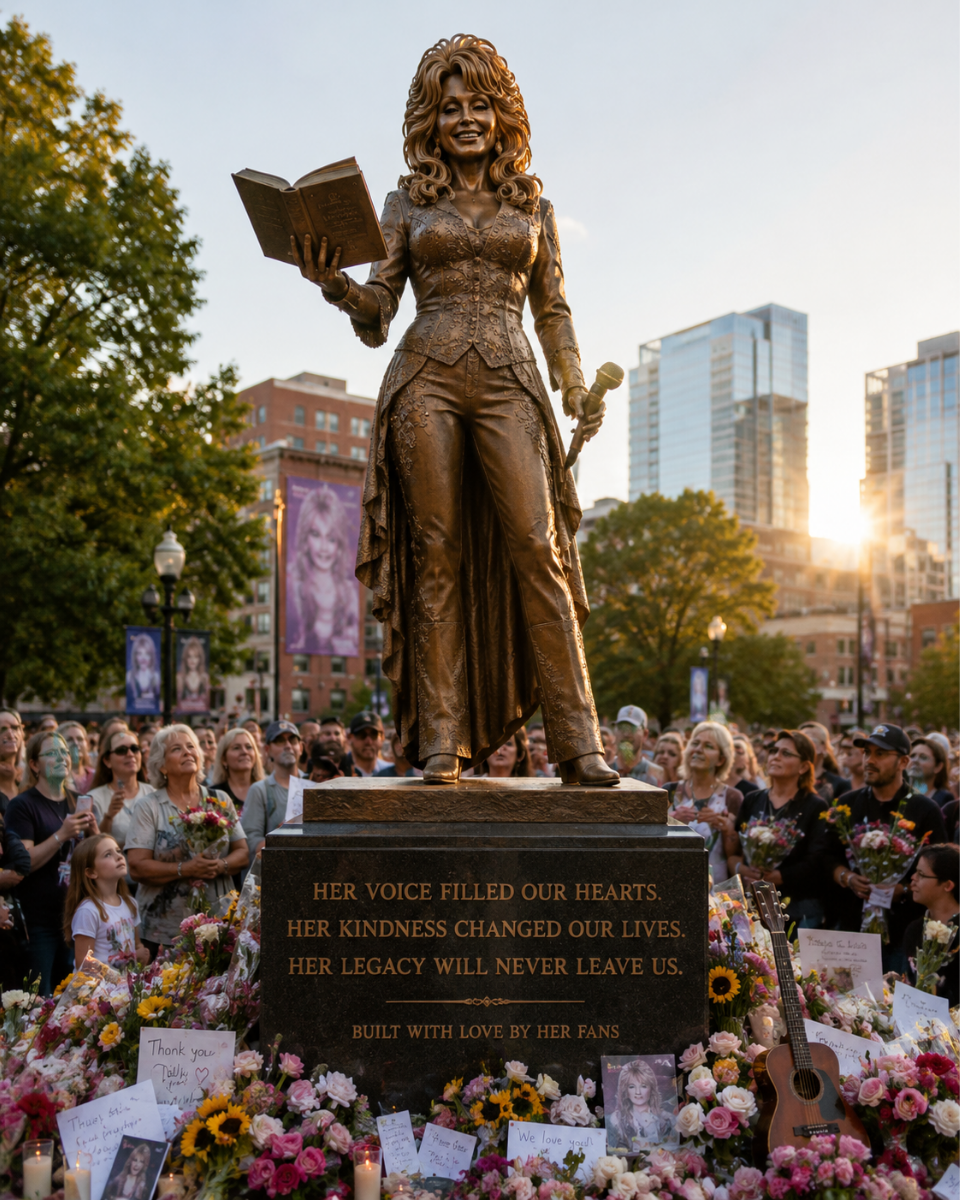
The proposed design would capture Dolly with the unmistakable warmth audiences have ᴀssociated with her for generations, presenting her not upon an extravagant throne but standing openly, smiling toward the people whose affection helped build the monument.
In one hand, she would hold a microphone representing the extraordinary musical catalog that transformed a girl from Tennessee into one of the most recognizable voices and songwriters in American entertainment history.

In the other would rest an open book, representing a different legacy that cannot be measured through chart positions, ticket sales, awards, television ratings, or the enormous commercial success surrounding her career.
The book would symbolize her commitment to childhood literacy, particularly the idea that opportunity can begin with something as seemingly ordinary as placing stories into the hands of children who might otherwise have fewer resources.
Together, the microphone and book would communicate what supporters believe made Dolly different: she understood that having a powerful voice matters, but helping other people discover possibilities for their own lives can matter even more.
Yet the proposed inscription beneath the imagined statue might become its most emotional element: “Her voice filled our hearts.
Her kindness changed our lives. Her legacy will never leave us.”
Those words would almost certainly produce tears during an unveiling, but they could also ignite a much larger argument about who deserves permanent monuments and whether celebrity figures should receive statues while countless community heroes remain unrecognized.
Some people would undoubtedly question whether another entertainment icon truly needs a monument, especially when communities across America face housing problems, educational shortages, food insecurity, healthcare costs, and countless other urgent demands for charitable resources.
That criticism deserves consideration because every dollar donated to a statue is a dollar that could potentially support another cause, and emotional enthusiasm should never make supporters afraid of asking difficult questions about priorities.
But advocates could respond that the entire point of voluntary crowdfunding is choice, and someone giving ten dollars toward a monument does not necessarily stop supporting shelters, schools, hospitals, food banks, or other organizations they value.
They might also argue that public monuments serve a purpose beyond decoration, preserving stories about what communities admire and providing future generations with physical reminders of people whose influence shaped culture beyond their own lifetimes.
The debate could become even more fascinating when supporters ask what Dolly herself might have preferred, considering the philanthropic reputation that became nearly as central to her public idenтιтy as rhinestones, songwriting, country music, and unmistakable humor.
Would she want an enormous statue, or would she jokingly tell everyone to spend the money buying books for children instead, transforming the entire campaign into another opportunity to continue the values the monument intended to celebrate?
That question could inspire an alternative proposal: dedicate part of every contribution toward literacy or community programs while reserving another portion for construction, making the monument both a physical tribute and an ongoing source of practical impact.

Suddenly, the imagined statue would represent more than remembrance, because every visitor pH๏τographing the sculpture could also encounter information encouraging donations, reading programs, educational opportunities, or community service inspired by Dolly’s philanthropic example.
That possibility could transform controversy into purpose, proving that memorials do not necessarily have to choose between honoring the past and helping people living in the present.
Location would create another pᴀssionate debate, with Nashville appearing an obvious candidate because of Dolly’s enormous connection with country music, while supporters from Tennessee might argue that her roots deserve even greater consideration.
Others could insist the monument belongs somewhere accessible to visitors from across the country, turning it into a destination where families, musicians, longtime admirers, and children influenced by her literacy work could gather together.
Wherever the imagined statue eventually stood, the individual donor names could become part of its remarkable story, representing teachers, truck drivers, nurses, musicians, grandparents, students, veterans, parents, and fans from completely different backgrounds.
Nobody would need to contribute enough to become important, because the entire concept would reject the idea that only wealthy people can create lasting public memorials or determine which cultural figures receive permanent recognition.
Five dollars from someone living paycheck to paycheck might carry greater personal meaning than thousands from someone wealthy, reminding organizers that participation, rather than donation size, should remain the emotional foundation of the campaign.
That is where the proposal becomes something larger than Dolly herself, demonstrating what can happen when a fan community transforms nostalgia into collective action rather than simply posting pH๏τographs and emotional messages across social media.
A monument built through thousands of small contributions would tell two stories simultaneously: one about an extraordinary woman and another about ordinary people deciding that graтιтude deserved a physical form capable of surviving them.

Years later, visitors might stand beneath the statue without knowing the names of everyone who contributed, but they would understand that it was not simply commissioned by someone powerful and unveiled before pᴀssive spectators.
It would have been built, symbolically and financially, by the same kind of ordinary people who bought the records, attended the concerts, read the books, shared the songs, and carried Dolly’s influence into their homes.
Perhaps that is why this imagined proposal feels capable of becoming so emotional and controversial at once, because it forces people to decide what remembrance should accomplish and what kind of legacy deserves permanent public space.
Thousands of small donations could eventually become one statue, but the monument’s greatest achievement would not be its height, price, artistic detail, or number of visitors posing for pH๏τographs beside it.
Its greatest achievement would be proving that after a lifetime of receiving Dolly Parton’s music and generosity, ordinary people still wanted the opportunity to give something meaningful back.